Getting started with Microsoft Copilot doesn’t require perfect data, months of planning, or enterprise-scale resources. Small and medium-sized businesses running Microsoft 365 and Dynamics 365 Business Central are finding that the biggest barrier isn’t cost or complexity—it’s simply starting. The businesses making progress aren’t waiting for ideal conditions. They’re picking one low-risk task, testing Copilot with one person, and learning what works. Here’s what we’re seeing from teams that stopped planning and started testing.
What an Actual Microsoft Client Said About Getting Started with AI and Copilot
At a recent Microsoft conference, a VP of Digital Solutions and Enterprise Systems shared a mantra that stuck with me:
“With the tools you have, get started. Pick something low-risk. We started with Copilot, learned from it, and that led us to our next agent.”
This wasn’t said by a startup. Or a tech company experimenting in a lab.
It came from a VP managing operations at a large enterprise, and the advice applies just as much to small and medium-sized business teams modernizing finance, operations, and sales.
The message was simple: don’t wait for perfect conditions. The tools are already there.
The Gap Between “Interested” and “Started”
Most organizations move to Microsoft because they want productivity gains, control, and fewer manual headaches. AI is not a detour from that goal—it’s increasingly part of how Microsoft delivers it.
Here’s what we’re seeing: most small business leaders aren’t skeptical about Microsoft Copilot. They’re stuck.
Common hesitations we hear:
- “Our data isn’t clean enough yet”
- “We’re not sure which use case to start with”
- “It feels overwhelming—where do we even begin?”
- “We need to get everyone trained first”
- “What if we pick the wrong thing?”
BCS’ support manager, TJ, puts it simply: “It seems overwhelming at first. Once a client sees a demonstration or tries it, they realize it’s much easier than they thought.”
The barrier isn’t capability. It’s the mental weight of getting started.
What Actually Happens When Teams Start Using Microsoft Copilot
I asked the BCS team what changes once clients actually see Microsoft Copilot in action. Here’s what I heard:
The automation question gets specific. Instead of “Can AI help us?” it becomes “Can Microsoft Copilot pull data from this email and fill out this sales order in Dynamics 365 Business Central?” Real tasks. Real friction points. Real answers.
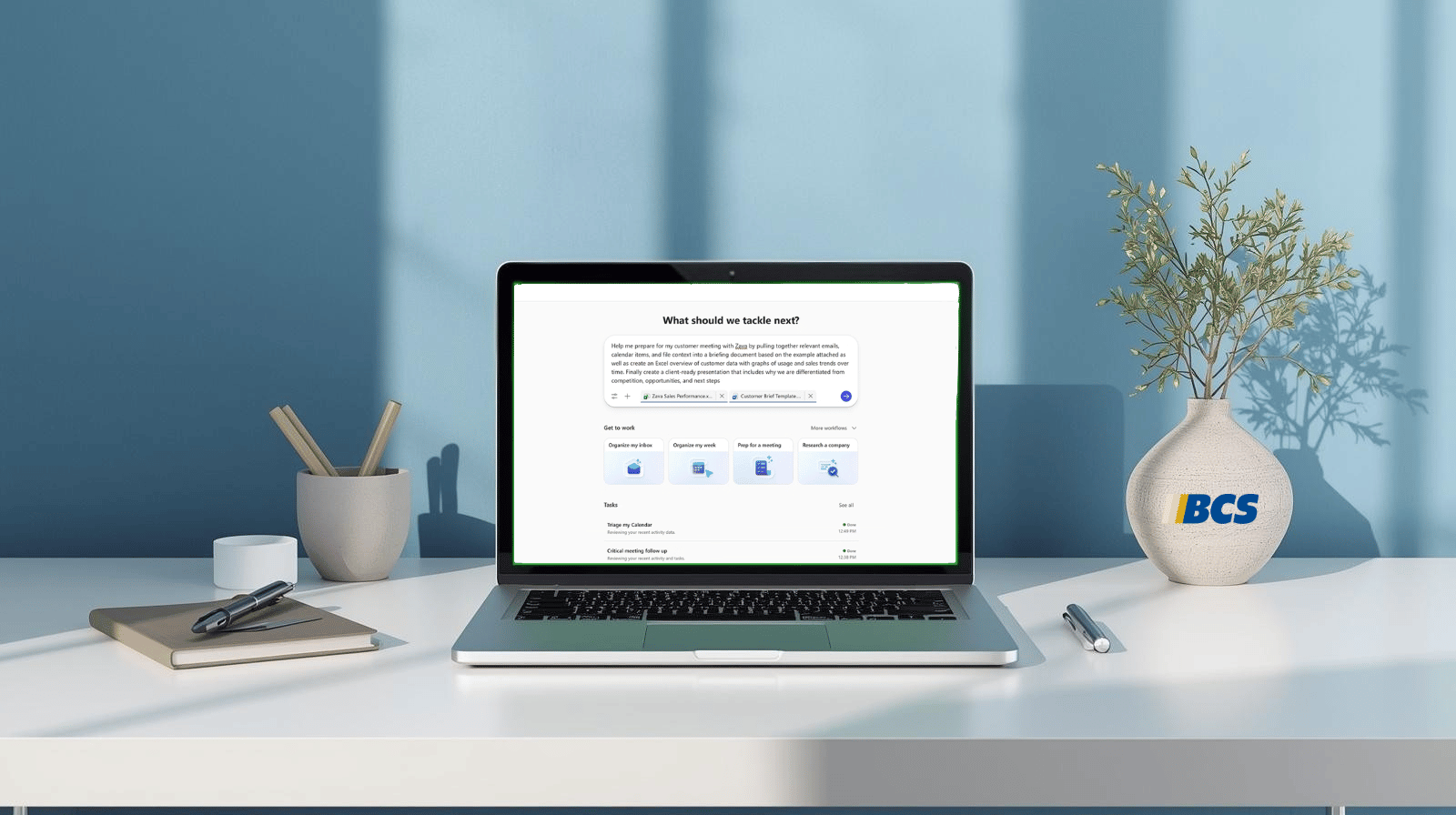
Daily efficiency becomes visible. When someone sees Copilot in Microsoft 365—drafting email responses in Outlook in seconds, summarizing meetings they couldn’t attend in Teams, or pulling together project notes they’d otherwise spend 20 minutes searching for—that’s when the light bulb turns on. It’s not theoretical anymore.
The clunky misconception disappears. A lot of small business owners have tried ChatGPT or Claude as a search tool and walked away unimpressed. They don’t realize Microsoft Copilot works inside their actual workflow—in Outlook, Teams, Excel, Business Central—where it can actually act on things, not just answer questions.
You Don’t Need Perfect Data to Start with Microsoft Copilot
One of the biggest myths the BCS team hears: “We’ll implement Copilot once we clean up our data.”
Here’s the truth: you’ll learn more about what needs cleaning by using Microsoft Copilot for two weeks than you will from six months of planning.
That same conference speaker described how their team began: They didn’t roll out a massive AI strategy. They didn’t wait for pristine data. They didn’t redesign every workflow. They picked one low-risk use case, stood it up quickly, and learned from it.
That first Microsoft Copilot experience:
- Helped surface gaps in customer experience
- Revealed where data needed improvement
- Created momentum for more targeted agents later
For many small and medium-sized businesses, Microsoft Copilot is the on-ramp, not the end state.
Where to Actually Start with Microsoft Copilot
Start with one person. One task. One week.
Sales team? Have someone use Copilot to summarize email threads before client calls.
Finance team? Let someone test it for drafting follow-up emails on overdue invoices.
Leadership? Use Copilot to prep for your next board meeting—pull together notes, draft an outline, generate talking points.
Pick something low-risk but high-frequency. Something people do every day. That’s where the value shows up fastest.
Why Some Teams Move Faster Than Others
The conference speaker mentioned something else: he’s not held back by legacy software investments. For most small and medium-sized businesses, though, that’s not the reality. You are tied to existing systems. You do have constraints.
That’s exactly why starting small matters. You don’t need to overhaul your tech stack to try Microsoft Copilot in Outlook. You don’t need to migrate to a new ERP to test an expense agent in Dynamics 365 Business Central. You can move forward with what you have.
Moving fast doesn’t mean reckless. It means not waiting for conditions that may never arrive.
The Culture Piece (It Still Matters)
Microsoft Copilot adoption isn’t just technical. It’s cultural. People worry:
- Will this make my role irrelevant?
- Am I expected to work differently now?
- What’s in it for me?
Without a clear story and visible leadership support, AI initiatives stall, even with the best tools available.
What works better:
- Leadership actively using Microsoft 365 Copilot themselves
- Framing AI as a way to do more with the same team, not replace it
- Making adoption part of how the organization modernizes, not a side experiment
When leadership models the behavior, the message doesn’t dilute as it moves through the organization.
The Takeaway: Don’t Architect the Future, Take the First Step
You don’t need to:
- Roll out agents everywhere
- Solve AI ROI perfectly upfront
- Be “fully on the Microsoft stack” on day one
You do need to start.
Microsoft has already put AI into Microsoft 365 and Dynamics 365 Business Central—tools many small businesses are evaluating or using today. Microsoft Copilot is often the safest, lowest-friction way to explore what AI actually does without locking yourself into something reckless or irreversible.
As that conference speaker put it during rehearsal: “The tools have been given to you. Don’t wait.”
Want help figuring out where to start with Microsoft Copilot?
BCS works with small and medium-sized businesses running Dynamics 365 and Microsoft 365 every day—helping them find the first practical use case that makes Copilot click.