

AI vs. Automation: How to Determine What Your Business Actually Needs
A Better Question
Is This Actually an AI Problem?
AI is everywhere. Every software vendor is talking about it. Every conference session mentions it. Every industry publication seems to suggest that if you’re not doing something with AI, you’re falling behind.
But most businesses don’t struggle to identify opportunities. They already have a list:
- Slow approvals
- Inventory discrepancies
- Manual data entry
- Forecasting challenges
- Reporting bottlenecks
- Scheduling issues
- Customer service requests
The hard part isn’t identifying the problems. It’s deciding what to do first and whether the answer is process improvement, automation, AI, or a combination.
This is where many businesses get stuck. This framework helps organizations determine whether a challenge is best addressed through process improvement, automation, AI, or a combination of approaches.
Operational Maturity
Build The Foundation First
Many organizations start by evaluating AI. The reality is that AI sits on top of everything else.
Before AI can create meaningful value, organizations need reliable data, consistent processes, and repeatable workflows.
Strong data creates strong processes.
Strong processes enable automation.
Automation creates the foundation for successful AI initiatives.

Data
Process Discipline
Automation
AI
Continuous Improvement
Three Question Test
Decision Framework for AI vs. Automation
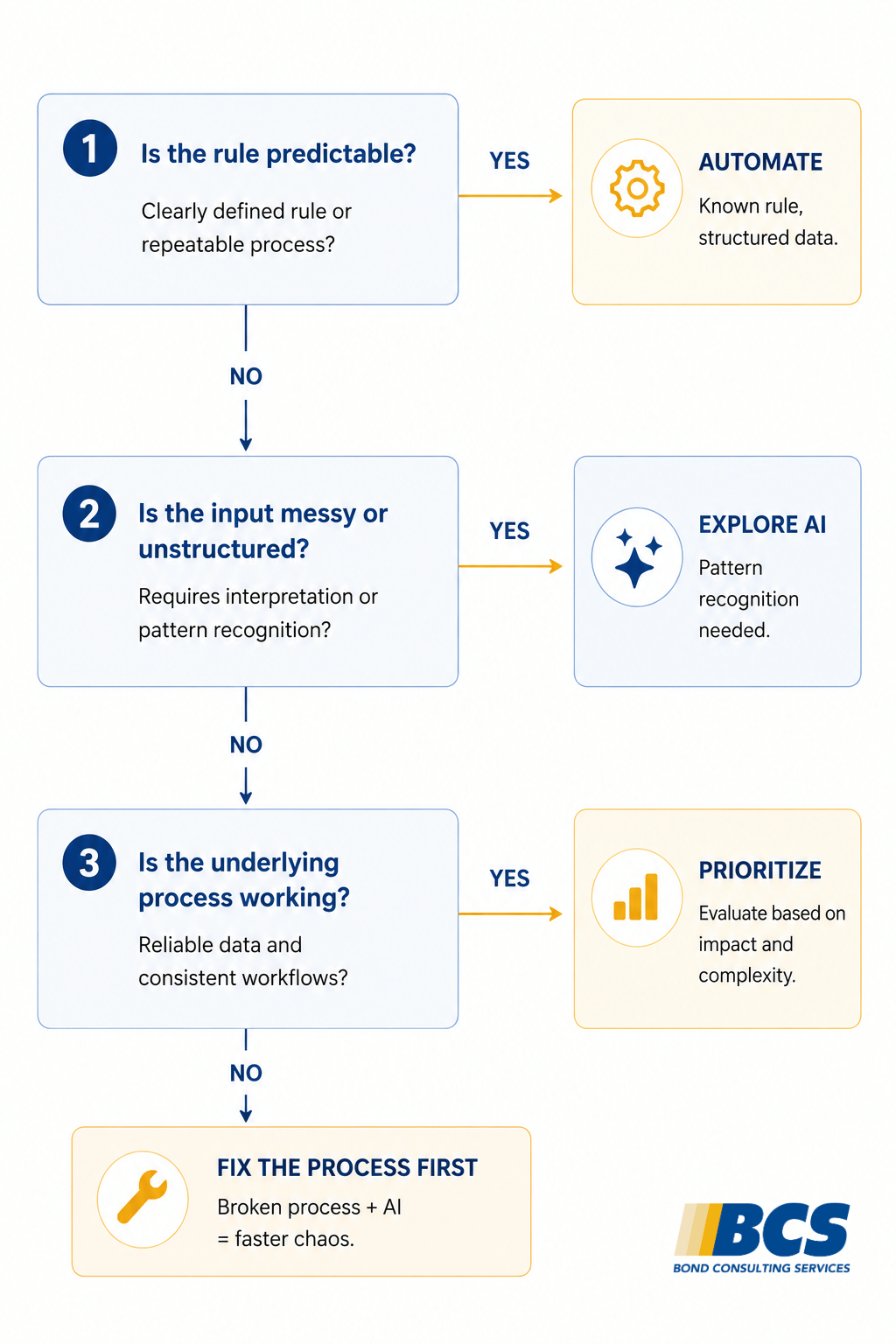
Before evaluating technology, ask three questions:
- Is the rule predictable?
- Is the input messy or unstructured?
- Is the underlying process working?
The answers often reveal the best path forward.
- If the rule is predictable, automation may be the answer.
- If the input requires interpretation, pattern recognition, or forecasting, AI may have a role.
- If the process itself is broken, fixing the process may create more value than implementing new technology.
Real-World Examples
Not Every Challenge Needs AI
Organizations often assume AI is the answer because it’s the newest technology available. In reality, many operational challenges can be solved faster and more cost effectively through process improvements or automation.
Common Business Scenarios
Challenge
Process
Automation
AI
Purchase Order Approval Delays
Inventory Accuracy Problems
Vendor Invoice Processing
Production Forecasting
Chatbot Requests
Depends
Depends
Depends
Prioritization
Focus On What Matters First
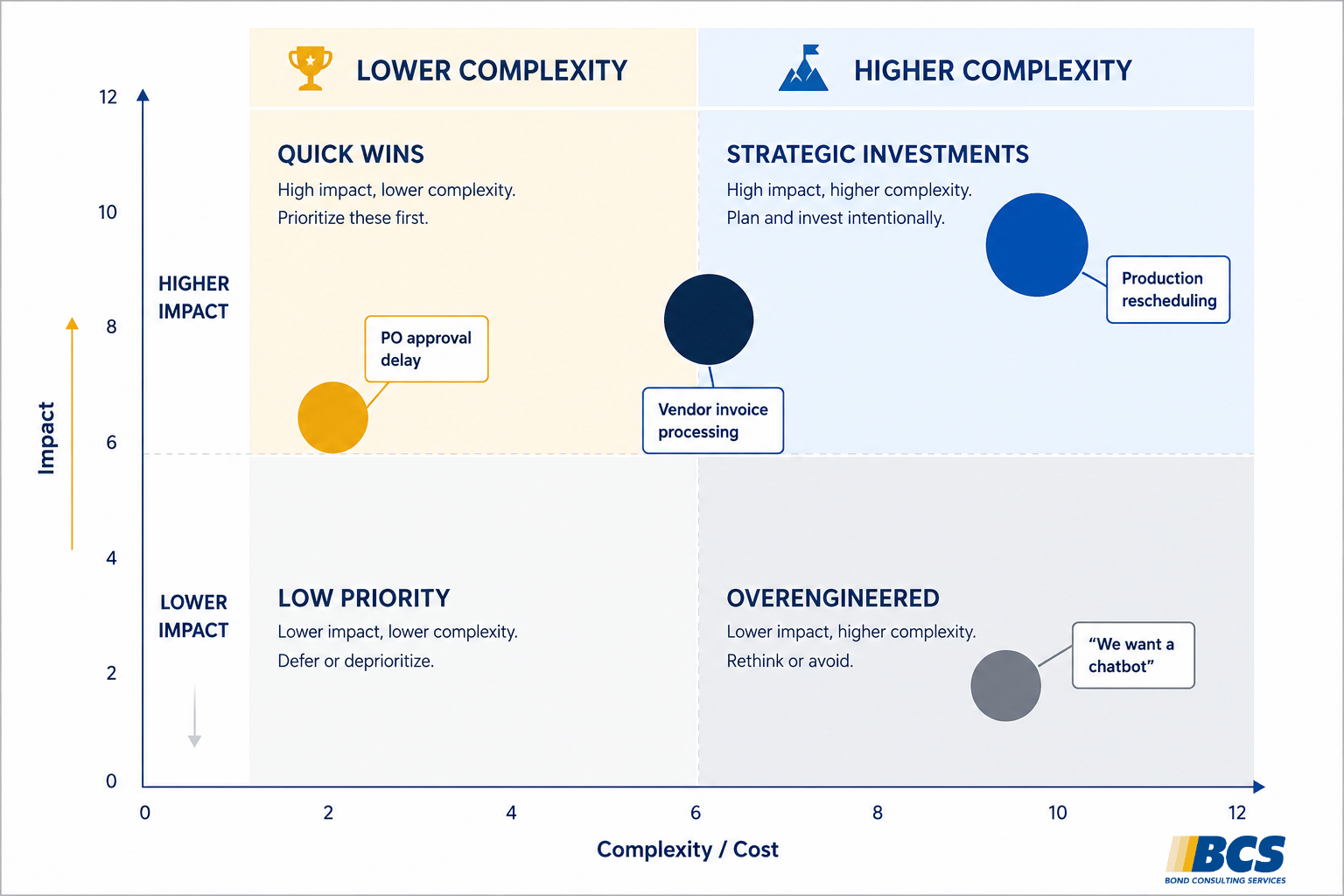
Most companies have more opportunities than resources. That’s why prioritization matters.
Instead of evaluating initiatives based on hype, evaluate them based on:
- Expected business impact
- Complexity
- Cost
- Time to value
Quick wins often create momentum, improve adoption, and build organizational confidence.
Organizations that start with high-impact, low-complexity opportunities frequently see faster results than those pursuing large AI projects from day one.
Watch The Session
See The Framework In Action
Watch the recorded Lunch & Learn where BCS walks through real-world examples and demonstrate how to evaluate opportunities using the Three Question Test and Prioritization Matrix.
Bring Us Your Challenges
Business Challenge Workshop
If you’re trying to decide what to tackle first, we’d be happy to help.
Bring your top operational challenges, and we’ll work through them together to identify quick wins, prioritize opportunities, and determine where process improvement, ERP capabilities, automation, and AI may fit.
Business Process Prioritization Workshop
- Completed prioritization matrix
- Recommended next steps
- Process, automation, and AI recommendations
- A clearer roadmap for moving forward
Frequently Asked Questions
AI, Automation, and Process Improvement FAQs
What is the difference between AI and automation?
Automation follows predefined rules to complete repetitive tasks. AI is designed to interpret information, recognize patterns, make predictions, or generate outputs when the answer is not always the same. If a process can be clearly defined with a set of rules, automation is often the best place to start.
Should I automate before implementing AI?
In many cases, yes. Organizations often see faster returns by improving processes and automating repetitive work before implementing AI. Strong automation creates consistency, improves data quality, and establishes a foundation that allows AI initiatives to deliver more value.
Can AI fix broken business processes?
No. AI can accelerate existing processes, but it does not automatically correct poor workflows, inconsistent data, or unclear business rules. In fact, AI often exposes process issues more quickly because it operates at greater speed and scale.
How do I know if my organization is ready for AI?
A good starting point is evaluating your existing processes and data. If your team trusts the information in your systems, follows consistent workflows, and can clearly define business objectives, you may be ready to explore AI opportunities. If data quality or process discipline remains a challenge, addressing those issues first may create greater value.
How do I determine whether a problem needs process improvement, automation, or AI?
Start by asking three questions:
- Is the rule predictable?
- Is the input messy or unstructured?
- Is the underlying process working?
If the rule is predictable, automation may be the answer. If the challenge involves interpretation, forecasting, or pattern recognition, AI may be appropriate. If the process itself is broken, process improvement should come first.
What business processes are best suited for automation?
Processes that follow predictable rules and occur repeatedly are often strong candidates for automation. Examples include approvals, notifications, data entry, workflow routing, document distribution, report generation, and system integrations.
What business processes are best suited for AI?
AI is often most effective when organizations need help interpreting information, identifying patterns, generating content, forecasting outcomes, or making recommendations. Examples include demand forecasting, invoice recognition, customer service assistance, anomaly detection, document summarization, and predictive analytics.
What is workflow automation?
Workflow automation uses technology to move work between people and systems without manual intervention. Common examples include approval workflows, automated notifications, document routing, data synchronization, and task assignments.
What are examples of automation in Microsoft Dynamics 365 Business Central?
Examples include purchase order approvals, invoice approvals, customer onboarding workflows, notifications, document routing, recurring processes, and integrations with Microsoft Power Automate and other Microsoft technologies.
What are examples of AI in Microsoft Business Central?
Examples include Microsoft Copilot capabilities, invoice recognition, forecasting assistance, natural language interactions, content generation, data analysis, and AI-powered recommendations that help users make decisions faster.
Is Microsoft Copilot AI or automation?
Microsoft Copilot is an AI capability. It uses large language models and business context to assist users with tasks such as summarization, content creation, analysis, recommendations, and natural language interactions. Organizations often achieve the greatest value when Copilot is layered onto well-defined processes and reliable data.
How should organizations prioritize AI opportunities?
Organizations should evaluate opportunities based on business impact, implementation complexity, cost, and expected time to value. Many organizations begin with high-impact, lower-complexity initiatives before pursuing larger strategic AI investments.
What are common signs an AI project may fail?
Common warning signs include poor data quality, undefined business objectives, inconsistent processes, lack of user adoption, unclear ownership, and implementing AI before addressing foundational operational issues.
What operational challenges should organizations tackle first?
Organizations often benefit from addressing challenges that create measurable business impact while remaining relatively straightforward to implement. Approval delays, reporting bottlenecks, manual data entry, workflow inefficiencies, and process inconsistencies are common starting points.
How can organizations evaluate AI opportunities more effectively?
Rather than starting with technology, start with the business problem. Define the desired outcome, evaluate the current process, assess data quality, and determine whether process improvement, automation, AI, or a combination of approaches is most likely to achieve the result.


